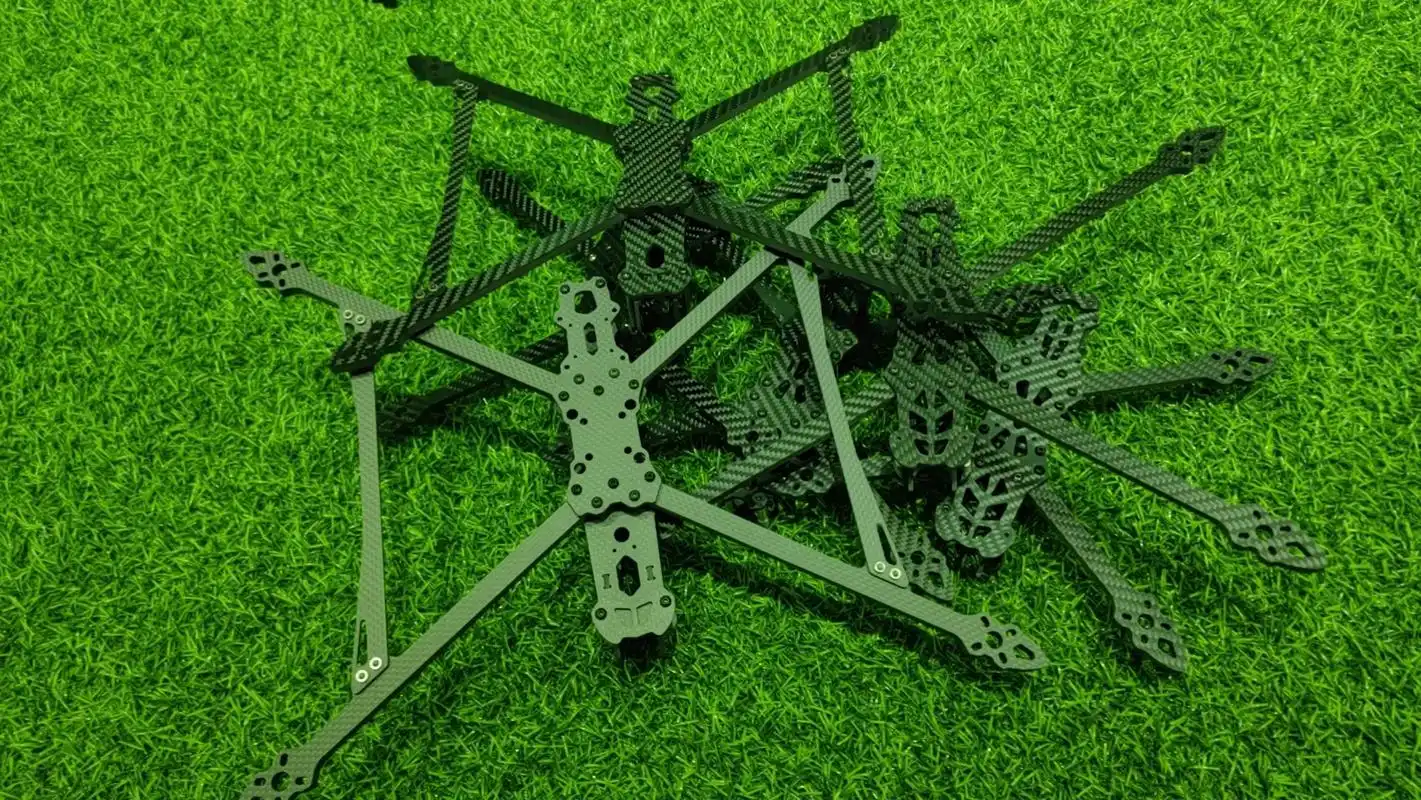
Why Drone Designers Choose Carbon Fiber Plates: The Ultimate Material Comparison
In the world of Unmanned Aerial Vehicles (UAVs), every gram counts. Whether you are designing a high-speed FPV racing quadcopter or a heavy-lift agricultural drone, the material you choose for the frame dictates the performance, flight time, and durability of the aircraft.
At E-YOUNG Composites, we often get asked: “Is carbon fiber really worth the investment compared to Aluminum or G10?”
The short answer is yes. The long answer lies in the physics of specific strength and vibration damping. Here is an expert breakdown of why carbon fiber plates are the gold standard for drone manufacturing.
The Golden Metric: Stiffness-to-Weight Ratio
The primary reason engineers select carbon fiber is its unrivaled Stiffness-to-Weight Ratio (Specific Modulus).
In drone dynamics, you need a frame that is incredibly rigid (to prevent arm flex during high-thrust maneuvers) but also incredibly light (to maximize battery life).
-
Aluminum (6061-T6): Has a density of approx. 2.7 g/cm³.
-
Carbon Fiber: Has a density of approx. 1.5 g/cm³.
Carbon fiber is almost 50% lighter than aluminum while offering superior tensile strength. This means a drone arm made of carbon fiber can be thicker and stronger than an aluminum counterpart while still weighing less. For a drone designer, this weight saving directly translates to longer flight times and higher payload capacity.
Carbon Fiber vs. G10/Fiberglass
G10 (Fiberglass laminate) is a common material for entry-level hobby drones because it is cheap and RF (Radio Frequency) transparent. However, for professional applications, it falls short.
-
Flexibility: G10 is much more flexible than carbon fiber. In a large drone, flexible arms cause instability in the PID controller, leading to “wobble” in the air. Carbon fiber is extremely stiff, ensuring the motors stay perfectly aligned.
-
Weight: G10 is denser and heavier than carbon fiber. Using G10 for a 5-inch or larger drone frame simply adds unnecessary “dead weight.”
Vibration Damping: The “Jello” Killer
ibrations from motors can reach the camera sensor, causing a rolling shutter effect known as “Jello.”
Carbon fiber has excellent natural vibration damping properties. Unlike metals like aluminum, which tend to “ring” and transmit high-frequency vibrations throughout the frame, the composite structure of carbon fiber (epoxy matrix + fibers) helps absorb and dissipate this energy.
Fatigue Resistance and Durability
Drones undergo constant stress cycles. Every time the motors spin up or the drone takes a hard corner, the arms are under load.
-
Metals have a fatigue limit; over time, repeated stress can cause microscopic cracks that lead to sudden failure.
-
Carbon Fiber has infinite fatigue life at lower stress levels. Unless you crash it and physically break the fibers, a carbon fiber plate will not lose its stiffness or strength over time.
Customizability for Specific Applications
Not all carbon fiber is the same. At E-YOUNG Composites, we allow designers to customize the material based on the drone’s purpose:
-
For FPV Crash Resistance: We use 3K Plain Weave. The tight interlace structure prevents fraying at the edges during a high-speed impact.
-
For Heavy Lifting (Rigidity): We recommend 3K Twill Weave or even Unidirectional (UD) layers in the core, specifically oriented to resist bending along the length of the arm.
While Aluminum and G10 have their place in budget builds, Carbon Fiber Plates are the only logical choice for high-performance UAVs. The combination of low density, high stiffness, and vibration absorption makes it the ultimate aerospace material.
Need high-quality carbon fiber for your next project? At E-YOUNG Composites, we manufacture premium plates with precise thicknesses ranging from 2mm to 6mm.


 English
  Arabic
  German
  Spanish
  French
  Italian
  Dutch
Dutch  Swedish
  Portuguese
  Korean